With the rapid growth of applications such as aerial photography, industrial inspection, agricultural protection, and logistics delivery, the civil drone market continues to expand. Drone systems are increasingly dependent on core electronic components, particularly key devices such as microcontrollers (MCUs), power management ICs, sensors, and communication modules.
However, in the real-world supply chain, companies are facing multiple challenges, including end-of-life (EOL) issues, extended lead times, and rising costs, making alternative solutions a critical demand. In this context, Ande Electronics features its strong supply chain resources and technical expertise to provide efficient replacement solutions for Holto chips, helping customers achieve stable supply and cost optimization.
Civil Drone System Architecture Overview
1. Core Modules of a Drone System
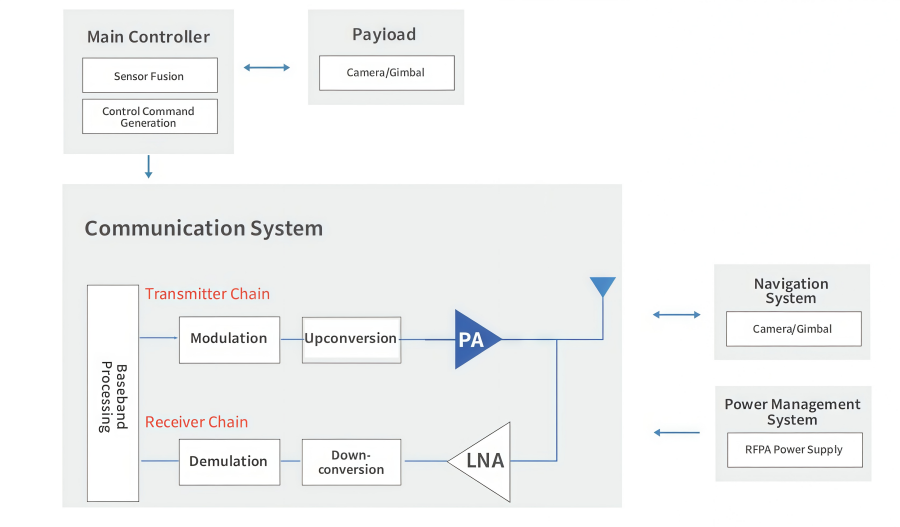
A civil drone system consists of several key functional modules working together to ensure stable flight and efficient data processing:
l Flight Control: Acts as the “brain” of the drone, responsible for attitude control, flight algorithm processing, and coordination of all subsystems, making it critical to overall stability.
l Power Management: Handles battery energy distribution and voltage regulation, providing stable power to each subsystem and directly affecting flight endurance and system reliability.
l Motor Drive: Controls brushless motors to generate thrust and execute flight movements, serving as a key part of the execution layer.
l Sensors (IMU / Barometer / GPS): Collect real-time data on orientation, altitude, and positioning, providing essential input for the flight control system.
l Communication: Enables remote control signal transmission and data link connectivity, ensuring stable communication between the drone and the ground station.
l Camera & Image Processing: Responsible for image capture, video transmission, and visual processing, widely used in applications such as aerial photography and inspection.
2. Application Block Diagram
Key Factors for Drone Chip Selection
In civil drone design, chip selection directly impacts overall performance, stability, and flight experience. The following factors should be carefully considered:
Power Consumption (Flight Time)
Low-power design helps extend battery life and is a key factor in maximizing flight duration.
Size and Packaging (Lightweight Design)
Compact and lightweight packages reduce overall system weight, improving flight efficiency and maneuverability.
EMI Resistance
Drones operate in complex environments, so strong electromagnetic interference (EMI) resistance ensures stable signal transmission and prevents flight anomalies.
Operating Temperature Range
Chips must support wide temperature ranges to handle outdoor conditions and ensure reliable long-term operation.
Real-Time Performance (Critical for Flight Control)
Flight control systems require high real-time performance. Fast response capability is essential for precise attitude control and accurate data processing.
Why Holto Replacement Is Needed?
In the context of rapid growth in civil drones and related embedded systems, the Holto chip replacement solutions provided by Ande Electronics address the common challenges of supply chain instability and rising cost pressure, making them a critical practical requirement:
1. Unstable Original Supply
Due to global semiconductor capacity fluctuations and regional supply chain constraints, certain Holto chip models are experiencing extended lead times, batch inconsistencies, and even intermittent supply shortages. This creates significant risks for industries such as drones that rely heavily on continuous component availability, especially during mass production and long-term maintenance phases.
2. Rising Costs
Driven by increasing market demand, changes in production allocation priorities, and higher logistics costs, the pricing of key Holto models continues to rise, resulting in higher overall BOM costs. In the highly competitive drone market, this directly reduces profit margins and weakens pricing competitiveness.
3. Lifecycle (EOL) Issues
Some Holto components are already approaching end-of-life (EOL) or are in phased discontinuation. This leads to risks such as unsustainable long-term supply, compressed replacement validation cycles, and potential redesign efforts, all of which challenge stable product iteration and long-term continuity.
Advantages of Ande Electronics Replacements
ANDE Electronics leverages a global supply chain network, integrating multi-region manufacturers and distribution channels to ensure stable and reliable chip supply. By covering major electronics markets across Asia, Europe, and North America, the company effectively reduces single-source supply risks and ensures continuity throughout both R&D and mass production stages of drone projects.
In terms of replacement solutions, Ande Electronics provides performance-equivalent or even upgraded alternatives, supported by Pin-to-Pin compatibility design and parameter matching analysis. This enables customers to quickly validate replacements for original Holto components. In addition, the company maintains strong in-stock availability and rapid delivery capabilities, significantly shortening procurement cycles and accelerating time-to-market for drone applications.
Furthermore, Ande Electronics offers comprehensive technical support services, including replacement validation testing and system-level component selection guidance. These capabilities allow the company to deliver tailored solutions that meet the high real-time performance and reliability requirements of the civil drone industry.
Holto Alternative Model Solutions
In UAV RF and power chain design, key selection factors include frequency coverage, output power capability, efficiency, and package compatibility. Ande Electronics provides a range of high-performance replacement solutions for Holto-related components, meeting the communication and power amplification requirements of different drone systems.
The HTN3D series (such as HTN3D60S015P, HTN3D60S060HB, and HTN3D30S060P) supports frequency coverage up to 7000 MHz. Operating at 28V, these devices offer output power levels ranging from 15W to 75W, achieve high efficiency of 62%–71%, and provide gain performance of 14–20 dB.
In addition, high-power models such as HTN3D60P120HB deliver up to 120W output within the 500–5900 MHz frequency range, making them suitable for long-range data links and high-power transmission modules.
Conclusion
Drone systems place extremely high demands on the stability and continuous supply of core chips, especially in critical areas such as flight control, power management, and communication links. Against the backdrop of increasing uncertainty in the global semiconductor supply chain, rising costs, and certain models entering their end-of-life (EOL) stage, replacement solutions for Holto-related components have gradually become an inevitable trend in industry development.
With its globalized supply chain resources and strong technical support capabilities, Ande Electronics is able to provide stable and reliable replacement solutions for Holto components. Ande has built a comprehensive service system that effectively helps drone companies reduce supply risks, optimize cost structures, and accelerate product time-to-market while enhancing overall market competitiveness.