26/10/22
STM32F767IIT6 MCU: Specs, Features and Applications
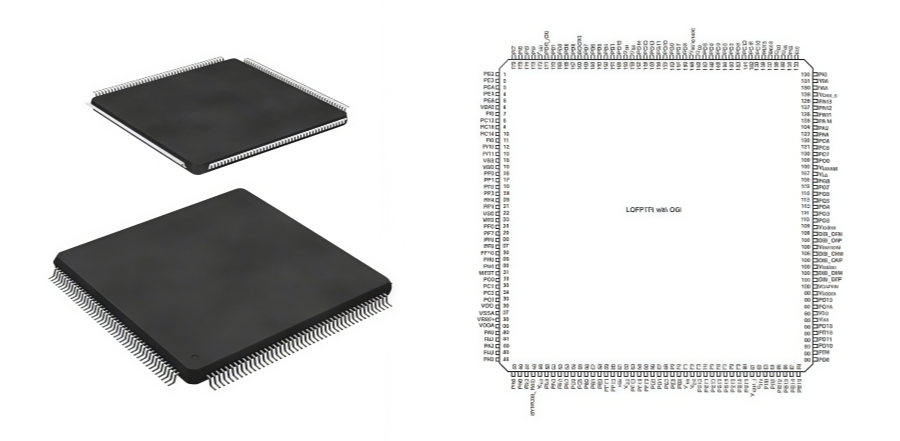
Introduction and Overview of STM32F767IIT6The STM32F767IIT6 is a microcontroller based on the Arm Cortex-M7 32-bit RISC core, operating at frequencies of up to 216 MHz. Its core integrates a floating-point unit (FPU) that supports both single-precision and double-precision operations, a digital signal processing (DSP) instruction set, and a memory protection unit (MPU). These features make it suitable for complex computations, real-time control, and embedded system development.In terms of memory and peripherals, the STM32F767IIT6 provides up to 2 MB of Flash memory and 512 KB of SRAM. It also features ADCs, DACs, timers, a random number generator, and a wide range of communication interfaces, including I²C, SPI, UART/USART, USB, CAN, and Ethernet. In addition, the device supports an LCD-TFT display controller, a Chrom-ART graphics accelerator, and flexible external memory interfaces.The STM32F767IIT6 supports a supply voltage range of 1.7–3.6 V. Devices in the associated series operate across a temperature range of -40°C to +105°C and offer multiple low-power modes.(Contact us for a quote) STM32F767IIT6 SpecificationsThis section lists the key specifications of the STM32F767IIT6 microcontroller.ParameterValuePart NumberSTM32F767IIT6ManufacturerSTMicroelectronicsDescriptionIC MCU 32BIT 2MB FLASH 176LQFPLead Free Status / RoHS StatusLead free / RoHS CompliantProgram Memory TypeFLASHProgram Memory Size2MB (2M x 8)RAM Size512K x 8Oscillator TypeInternalData ConvertersA/D 24x12b, A/D 2x12bCore ProcessorARM® Cortex®-M7Number of I/O140Speed216MHzCore Size32-BitVoltage - Supply (Vcc/Vdd)1.7 V ~ 3.6 VPackagingTrayOperating Temperature-40°C ~ 85°C (TA)Supplier Device Package176-LQFP (24x24)Package / Case176-LQFPBase Part NumberSTM32F7 Pinout and Interface ConfigurationThe STM32F767IIT6 comes in an LQFP176 package, providing extensive multiplexed I/O resources and strong peripheral expansion capabilities. Its pin layout distributes power pins (VDD, VSS, VDDA, etc.), analog reference inputs, and various high-speed communication interfaces around the package to help manage high-frequency switching noise and maintain signal integrity. Key Features of STM32F767IIT6l Includes ST state-of-the-art patented technologyl Core: Arm® 32-bit Cortex®-M7 CPU with DPFPU, ART Accelerator and L1-cache: 16 Kbytes I/D cache, allowing 0-wait state execution from embedded flash memory and external memories, up to 216 MHz, MPU, 462 DMIPS/2.14 DMIPS/MHz (Dhrystone 2.1), and DSP instructions.l Memories– Up to 2 Mbytes of flash memory, organized into two banks allowing read-while-write– SRAM: 512 Kbytes (including 128 Kbytes of data TCM RAM for critical real-time data)+ 16 Kbytes of instruction TCM RAM (for critical real-time routines) + 4 Kbytes of backup– Flexible external memory controller with up to 32-bit data bus: SRAM, PSRAM, SDRAM/LPSDR SDRAM, NOR/NAND memoriesl Dual mode Quad-SPIl Graphics– Chrom-ART Accelerator (DMA2D), graphical hardware accelerator enabling enhanced graphical user interface– Hardware JPEG codec– LCD-TFT controller supporting up to XGA resolution– MIPI® DSI host controller supporting up to 720p 30 Hz resolutionl Clock, reset and supply management– 1.7 to 3.6 V application supply and I/Os– POR, PDR, PVD and BOR– Dedicated USB power– 4-to-26 MHz crystal oscillator– Internal 16 MHz factory-trimmed RC (1% accuracy)– 32 kHz oscillator for RTC with calibration– Internal 32 kHz RC with calibrationl Low-power– Sleep, Stop and Standby modes–VBAT supply for RTC, 32×32 bit backup registers + 4 Kbytes backup SRAM3×12-bit, 2.4 MSPS ADC: up to 24 channelsl Digital filters for sigma delta modulator (DFSDM), 8 channels / 4 filtersl 2×12-bit D/A convertersl General-purpose DMA: 16-stream DMA controller with FIFOs and burst supportl Up to 18 timers: up to thirteen 16-bit (1x lowpower 16-bit timer available in Stop mode) and two 32-bit timers, each with up to four IC/OC/PWM or pulse counter and quadrature (incremental) encoder input. All 15 timers running up to 216 MHz. 2x watchdogs, SysTick timerl Debug mode– SWD and JTAG interfaces– Cortex®-M7 Trace Macrocell™l Up to 168 I/O ports with interrupt capability– Up to 164 fast I/Os up to 108 MHz– Up to 166 5 V-tolerant I/Os(Contact us for a quote) ARM Cortex-M7 Core Architecture and PerformanceThe STM32F767IIT6 features STMicroelectronics’ high-performance ARM Cortex-M7 32-bit RISC core, based on the ARMv7-M architecture, with a maximum clock speed of 216 MHz. Its key architectural advantages include: 1. L1 CacheThe Cortex-M7 integrates L1 instruction cache (I-Cache) and data cache (D-Cache). These caches reduce CPU stalls caused by Flash access, improving code execution and data processing efficiency. 2. Hardware FPUThe chip includes a high-performance hardware floating-point unit (FPU) compliant with IEEE 754. It supports single-precision operations and accelerates mathematical computations such as PID control, digital filtering, and Fast Fourier Transform (FFT), reducing execution time compared with software-based calculations. 3. Double-Precision ComputingIn addition to single-precision operations, the Cortex-M7 supports hardware-accelerated double-precision (64-bit) floating-point calculations. This benefits applications requiring high-precision scientific computing, precision measurements, and complex matrix operations. 4. Support for Complex AlgorithmsWith a clock speed of up to 216 MHz, the Cortex-M7 handles real-time control tasks and runs embedded operating systems such as FreeRTOS and ThreadX, as well as computationally intensive algorithms. Memory Organization: Flash and SRAM CapacityThe STM32F767IIT6 features up to 2 MB of Flash and 512 KB of SRAM, with a multi-level memory architecture designed for high-speed, real-time data processing.l 2 MB Dual-Bank Flash: Provides ample space for embedded operating systems such as FreeRTOS, protocol stacks, and GUI assets. The dual-bank architecture supports read-while-write operations, enabling firmware updates while the application continues running, subject to implementation requirements.l 512 KB SRAM and TCM: The device provides 512 KB of SRAM for data buffers and network packets. Its Instruction Tightly Coupled Memory (ITCM) and Data Tightly Coupled Memory (DTCM) connect directly to the Cortex-M7 core, enabling low-latency access.l Optimized Real-Time Processing: Developers can place time-critical algorithms, digital filters, and interrupt routines in ITCM, while storing frequently accessed real-time variables in DTCM to improve execution efficiency. Typical Applications of STM32F767IIT6 MCUThe microcontroller is suitable for a wide range of applications thanks to its high processing performance, rich peripheral interfaces, and real-time control capabilities. Typical applications include: 1. Motor Drives and Application ControlThe STM32F767IIT6 is suitable for controlling BLDC motors, servo motors, and other motor-driven systems that require fast response and accurate speed regulation. 2. Medical EquipmentIt can be used in medical equipment such as patient monitoring systems, diagnostic instruments, and portable medical devices. 3. Industrial ApplicationsThe STM32F767IIT6 is good for industrial control systems, including programmable logic controllers (PLCs), inverters, and circuit breakers. 4. Printers and ScannersThe MCU can manage data processing, motor control, and communication in printers and scanners. 5. Alarm Systems, Video Intercoms, and HVACThe STM32F767IIT6 can serve as a control unit in security and building automation systems. It supports sensor data acquisition, alarm processing, communication, user interface control, and more. 6. Home Audio AppliancesThe STM32F767IIT6 can handle audio signal processing and system control in home audio equipment. Typical applications include audio processors, digital amplifiers, and smart speakers. 7. Mobile Applications and Internet of Things (IoT)The STM32F767IIT6 provides the processing power and connectivity interfaces needed for IoT devices and portable electronic systems. 8. Wearable DevicesThe microcontroller can support wearable devices such as smartwatches that require sensor data processing, display control, and wireless communication through external modules. ANDE Electronics: Your Trusted Partner in Electronic Component Sourcing At ANDE Electronics, we make getting the electronic components you need simple and fast. We work directly with top global manufacturers to provide high-quality components that have passed our strict checks, so you can count on them for your projects.We also focus on quick and consistent delivery to keep your work on schedule and avoid delays. When you need reliable and efficient electronic parts for your projects, ANDE Electronics is a partner you can trust.(Contact us for a quote)
322
26/10/19
NEC NL6448BC26-09: 8.4-Inch TFT-LCD Display Module
Introduction and Overview of NL6448BC26-09The NL6448BC26-09 is a color LCD module that uses amorphous silicon thin-film transistor (a-Si TFT) technology. It consists mainly of a TFT-LCD panel, driver integrated circuits (Driver LSIs), and a backlight unit. This model features an 8.4-inch display with a resolution of 640 × 480 pixels (VGA), making it suitable for industrial and embedded equipment. The liquid crystal layer is located between the TFT array glass substrate and the color-filter glass substrate, regulating light transmission through the optical properties of the liquid crystals.During operation, red, green, and blue (RGB) image signals from the host system are processed by a signal processing circuit and then sent to the driver ICs, which control the individual pixels in the TFT array. The TFTs act as electro-optical switches, regulating the amount of light passing through the liquid crystal layer and color filters. By controlling the light transmission of the RGB subpixels, the module produces color images. The NL6448BC26-09 uses a cold-cathode fluorescent lamp (CCFL) backlight system, with a typical brightness of approximately 450 cd/m² and a typical contrast ratio of 600:1, meeting the display needs of various legacy equipment.(Contact us for a quote) Key Technical Specifications and ParametersThe table below presents the core specifications of NL6448BC26-09, detailing its performance and application requirements.ParameterSpecificationModelNL6448BC26-09BrandNECDisplay Size8.4"CompositionLCMResolution640(RGB)×480, VGA 95PPILuminance450 cd/m² (Typ.)Contrast Ratio600:1 (Typ.) (TM)Viewing Angle80/80/80/60Color Depth262K 40% NTSCLight Source2 pcs CCFL , 50K hours , No DriverInterface TypeCMOS (1 ch, 6-bit) , 31 pins ConnectorPixel FormatRGB Vertical StripeActive Area174.0(W)×131.4(H) mmFrame Rate60HzTouchscreenWithoutVoltage Supply3.3/5.0V (Typ.)Weight330/350g (Typ./Max.)Outline Size200(W)×152(H)×11(D) mmVibration Level2.0G (19.6 m/s²)Max RatingsOperating Temp.: -20 ~ 70 °C ; Storage Temp.: -30 ~ 85 °C Optical Performance and Display QualityThe NL6448BC26-09 offers a typical brightness of 450 cd/m², keeping images bright and readable in industrial control environments with strong indoor lighting or ambient light. It also features a typical static contrast ratio of 600:1, delivering clear distinctions between light and dark areas and sharp edges for UI icons and text. These characteristics help improve readability when operators need to monitor data for extended periods.In addition, the module features a wide-viewing-angle design, with typical viewing angles of 80° from the top, 60° from the bottom, and 80° from both the left and right. This helps maintain image visibility when viewed from different positions. Its surface features anti-glare treatment and a 3H hard coating, which help reduce reflections and provide resistance to minor scratches during normal use and cleaning. These features support practical use in industrial environments, although actual performance depends on installation conditions and handling. CCFL Backlight: Design and Maintenance ConsiderationsThe cold cathode fluorescent lamp (CCFL) backlight provides high-brightness, uniform illumination for the NL6448BC26-09 module. However, its high-voltage AC operation requires specific design and maintenance considerations. 1. Inverter and Electrical DesignHigh Voltage & Striking: Requires a dedicated inverter delivering over 1,000V AC starting voltage and stable operating current. Maintain proper PCB clearance to prevent electrical arcing.Current & Thermal Control: Drive the CCFL within specified current limits to avoid flickering or premature aging. Design sufficient heat dissipation to prevent thermal buildup inside the housing. 2. Maintenance GuidelinesLifespan & Replacement: Rated for 40,000–50,000 hours to half-brightness. Reddish tint, reduced brightness, or delayed ignition signal tube degradation; replace with matching CCFL assemblies.Safety & Inspection: Always disconnect power before servicing high-voltage circuits. Check inverter fuses, BLON control signals, and wiring harness integrity when troubleshooting lighting failure. Signal Interface and Pin ConfigurationThe NL6448BC26-09 industrial LCD module uses a standard 6-bit CMOS/TTL parallel interface, supporting 262,144 colors. It features a 31-pin connector with dedicated pins for RGB data signals, horizontal and vertical synchronization signals (HSYNC/VSYNC), the data enable (DE) signal, and 3.3V/5.0V logic power supplies, arranged to support reliable signal transmission and power delivery. Pin ConfigurationPin NumberSymbolPin NumberSymbol1GND2CLK3Hsync4Vsync5GND6R07R18R29R310R411R512GND13G014G115G216G317G418G519GND20B021B122B223B324B425B526GND27DE28VCC29VCC30N.C.31DPS(Contact us for a quote) Features and BenefitsThe NL6448BC26-09 uses proven TFT-LCD technology to deliver clear color images and stable display performance. Its key features help improve screen readability and make everyday operation more convenient.l Uses a-Si TFT technology for color image display.l Features a built-in CCFL backlight system without an integrated backlight driver.l Supports backlight lamp replacement for maintenance.l Offers a rated lamp life of at least 50,000 hours.l Operates in temperatures from -20°C to +70°C.l Supports storage temperatures from -30°C to +80°C.l Supports a maximum vibration level of 2.0G (19.6 m/s²).l Supports 180-degree image reversal for flexible installation. Industrial Applications and Use CasesThe NL6448BC26-09 is suitable for various industrial devices, displaying user interfaces, operating status, and monitoring data. The following sections introduce its main application areas. 1. Industrial Automation and Control SystemsThe NL6448BC26-09 can be used in industrial automation systems to display machine status, process parameters, and control information. It helps operators monitor equipment operation and interact with control interfaces during production.l Factory automation controllersl Production line monitoring systems 2. CNC Machines and Machine ToolsIn CNC machines and industrial machine tools, the NL6448BC26-09 can display machining parameters, tool status, operating instructions, and alarm messages. Its display capabilities support routine machine operation and status monitoring in manufacturing environments.l CNC milling machinesl CNC lathesl Industrial cutting machines 3. Industrial Testing and Measurement EquipmentThe NL6448BC26-09 can serve as a display module in testing and measurement instruments, presenting measurement readings, test results, and equipment status. l Electrical test instrumentsl Industrial data acquisition systemsl Automated test equipment (ATE) 4. Process Control and Monitoring SystemsIndustrial process control systems require displays for real-time process data, equipment conditions, and alarm notifications. The NL6448BC26-09 can be integrated into operator interfaces to help personnel monitor production processes and respond to abnormal conditions.l Chemical process control panelsl Water treatment monitoring systemsl Industrial temperature control units NL6448BC26-09 DatasheetYou can refer to the official datasheet of NEC NL6448BC26-09 LCD to see more details:Datasheet PDF Frequently Asked QuestionsWhat is the NL6448BC26-09 LCD module?The NL6448BC26-09 is an 8.4-inch a-Si TFT-LCD module from NEC LCD Technologies, designed for industrial and embedded display applications. What type of backlight does the NL6448BC26-09 use?The NL6448BC26-09 uses a CCFL (Cold Cathode Fluorescent Lamp) backlight system. It does not include an integrated backlight driver, so a compatible external inverter is required. Does the NL6448BC26-09 support touch input?No. The NL6448BC26-09 does not have a built-in touchscreen. Touch functionality would require a separate compatible touch panel and controller. What should be checked when replacing the NL6448BC26-09?Check the display dimensions, resolution, connector and pinout, interface signals, power requirements, mounting structure, and CCFL backlight drive requirements. A replacement should be confirmed against the original equipment specifications and the module's datasheet. ANDE Electronics: Reliable LCD Display Solutions As a professional display supplier, Ande Electronics is committed to providing LCD modules that meet modern application needs.We offer not only high-quality display products but also reliable technical support and flexible purchasing options. Our experienced engineering team works closely with customers to provide guidance on module selection, integration, and optimization.Choosing Ande Electronics, then engineers and manufacturers will gain a partner focused on quality, innovation, and efficiency.(Contact us for a quote)
127
26/10/15
IRF7103TRPBF MOSFET: Pinout and Circuit Applications
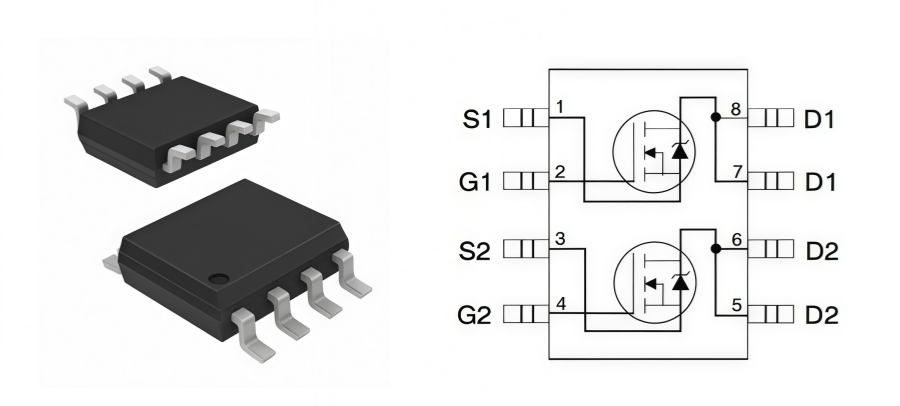
What Is the IRF7103TRPBF?The IRF7103TRPBF is a dual N-channel power MOSFET housed in an SO-8 surface-mount package. It integrates two N-channel MOSFETs and has a drain-to-source voltage rating of 50V. Built on advanced HEXFET® planar technology, it significantly reduces on-resistance per unit area of silicon.The device also features low gate charge and fast switching capability, with a maximum operating junction temperature of 150°C. The suffix "TRPBF" indicates tape-and-reel packaging for surface-mount assembly and compliance with RoHS lead-free requirements. It is commonly used in power management, load switching, and other power control circuits.(Contact us for a quote) How Does the IRF7103TRPBF Work?The IRF7103TRPBF operates using the electric-field control of N-channel enhancement-mode MOSFETs. It integrates two independent MOSFETs, each with a gate, source, and drain. When the gate-source voltage (VGS) exceeds the threshold voltage (typically 1.0–3.0 V), a conductive channel forms, allowing current to flow. When VGS falls below the threshold or reaches 0 V, the channel turns off, enabling fast switching.Built on Infineon’s HEXFET® technology, the device offers low on-resistance (as low as 0.13 Ω at VGS = 10 V), reducing conduction losses. Its two independently controlled channels can operate as separate switches or be used in suitable power-control circuits. With PWM signals, it can help regulate power to motors and other loads. Technical SpecificationsThis section lists the key specifications of the IRF7103TRPBF dual N-channel power MOSFET.ParameterValuePart NumberIRF7103TRPBFManufacturerInfineon TechnologiesDescriptionMOSFET 2N-CH 50V 3A 8-SOICLead Free Status / RoHS StatusLead free / RoHS CompliantRds On (Max) @ Id, Vgs130 mOhm @ 3A, 10VFET FeatureStandardFET Type2 N-Channel (Dual)SeriesHEXFET®Drain to Source Voltage (Vdss)50VGate Charge (Qg) (Max) @ Vgs30nC @ 10VPower - Max2WVgs(th) (Max) @ Id3V @ 250µACurrent - Continuous Drain (Id) @ 25°C3AMounting TypeSurface MountInput Capacitance (Ciss) (Max) @ Vds290pF @ 25VPackagingCut Tape (CT)Operating Temperature-55°C ~ 150°C (TJ)Supplier Device Package8-SOPackage / Case8-SOIC (0.154, 3.90mm Width)Base Part NumberIRF7103PBF Dual N-Channel Architecture BenefitsThe IRF7103TRPBF integrates two independent N-channel MOSFETs in a single SO-8 surface-mount package, optimizing PCB space. Compared with using two separate single-channel MOSFETs, this design can reduce board space, simplify routing, and lower component count and BOM complexity.The shared package supports compact thermal and electrical integration. Shorter current paths can help reduce parasitic inductance and resistance in high-frequency switching circuits, minimizing voltage spikes and improving signal integrity. The compact layout also allows for a more centralized thermal copper area, helping improve heat dissipation and system stability. Pin Configuration The IRF7103TRPBF comes in a standard 8-pin SO-8 package. Here are its pin descriptions listed:The IRF7103TRPBF comes in a standard 8-pin SO-8 package. Here are its pin descriptions listed:Pin 1 (S1): Source 1 – Current outlet/ground connection for Channel 1.Pin 2 (G1): Gate 1 – Gate drive control signal input for Channel 1. Pin 3 (S2): Source 2 – Current outlet/ground connection for Channel 2.Pin 4 (G2): Gate 2 – Gate drive control signal input for Channel 2.Pin 5 (D2): Drain 2 – Current inlet for Channel 2 (internally connected to Pin 6).Pin 6 (D2): Drain 2 – Current inlet for Channel 2 (internally connected to Pin 5 for power dissipation and conduction).Pin 7 (D1): Drain 1 – Current inlet for Channel 1 (internally connected to Pin 8).Pin 8 (D1): Drain 1 – Current inlet for Channel 1 (internally connected to Pin 7 for power dissipation and conduction). Power Dissipation and Thermal ManagementThe total power dissipation of the IRF7103TRPBF consists mainly of conduction losses (Pcond=I²RDS(on)) and switching losses at high frequencies. Due to its compact SO-8 package, heat must be dissipated primarily through the PCB pins and copper areas. Key Thermal Parameters and Design Recommendations:l Key Parameters: Junction-to-ambient thermal resistance (RθJA) ≈ 62.5°C/W, maximum junction temperature (Tj) = 150°C, and maximum power dissipation of approximately 2.0 W at an ambient temperature of 25°C.l Drain Pin Copper Area: Use the internal drain connections at pins 5/6 (D2) and pins 7/8 (D1) to provide large 2 oz copper areas for heat dissipation.l Thermal Vias and Derating: Add thermal vias beneath the pads to connect to internal or bottom-layer ground planes. At ambient temperatures above 50°C, derate the current as needed to keep the junction temperature below 120°C.(Contact us for a quote) Gate Drive Requirements & Logic Compatibility1. Drive Voltage vs. On-Resistance (VGS vs. RDS(on))l Recommended Drive Voltage: A standard gate-drive voltage of 10 V provides low on-resistance (RDS(on) ≤ 0.13 Ω), minimizing conduction losses.l Voltage Limits: The maximum gate-source voltage is ±20 V. A practical drive voltage of 10–15 V is recommended, subject to datasheet specifications. 2. Logic-Level Compatibilityl Threshold Voltage: The gate-source threshold voltage (VGS(th)) is 1.0–3.0 V.l Direct MCU Drive Risks: Directly driving high-current loads from 3.3 V or 5 V MCU GPIO pins is not recommended, as the MOSFET may not turn on fully and could overheat.l Design Recommendation: Use a gate driver IC or level-shifting circuit between the MCU and the gate to provide an appropriate drive voltage, such as 10 V. 3. Gate Drive Circuit Designl Low Gate Charge: With a typical gate charge (Qg) of approximately 12 nC, the device can be suitable for high-frequency PWM switching, depending on the driver capability.l Recommended Gate Resistor: A series gate resistor of 10–47 Ω can help suppress high-frequency oscillations.l Gate Pull-Down Resistor: A 10 kΩ resistor between gate and source helps ensure reliable turn-off. Peak Diode Recovery dv/dt Test Circuit Typical Application ScenariosThe IRF7103TRPBF is suitable for space-constrained power switching and control circuits. Typical applications include: DC-DC ConvertersIt is commonly used as a switching device in buck or boost converter designs when voltage, current, and switching requirements are met. Power Management CircuitsThe IRF7103TRPBF supports power switching and control in compact electronic systems. Load SwitchingIt controls power delivery to electronic loads in embedded systems and consumer electronics. Battery-Powered DevicesThe MOSFET can be used in battery power switching and power-path control circuits within its electrical ratings. Motor Control CircuitsThe IRF7103TRPBF is suitable for switching small motor loads when the current, thermal limits, and drive requirements are properly managed. SO-8 Package Outline ANDE Electronics: Your Trusted Partner in Electronic Component Sourcing At ANDE Electronics, we make getting the electronic components you need simple and fast. We work directly with top global manufacturers to provide high-quality components that have passed our strict checks, so you can count on them for your projects.We also focus on quick and consistent delivery to keep your work on schedule and avoid delays. When you need reliable and efficient electronic parts for your projects, ANDE Electronics is a partner you can trust.(Contact us for a quote)
184

26/10/12
AUO G084SN05 V9 TFT-LCD Display: Specs & Applications
G084SN05 V9 OverviewThe G084SN05 V9 is a TFT-LCD module designed for industrial applications. It features SVGA resolution with 800 (H) × 600 (V) pixels. The module has a built-in timing controller (TCON) and uses an LVDS interface. It supports approximately 16.7 million colors in RGB 8-bit mode or 262,000 colors in RGB 6-bit mode.The module integrates an LED driver board for the backlight and features a replaceable LED unit structure, making maintenance and backlight replacement more convenient. In addition, the G084SN05 V9 complies with RoHS requirements, helping meet restrictions on hazardous substances in electronic products.(Contact us for a quote) G084SN05 V9 Specifications The table below presents the core specifications of G084SN05 V9, detailing its performance and application requirements.ParameterSpecificationModelG084SN05 V9BrandAUODisplay Size8.4"CompositionLCMResolution800(RGB)×600, SVGA 119PPILuminance450 cd/m² (Typ.)Contrast Ratio600:1 (Typ.) (TM)Viewing Angle80/80/80/60Color Depth262K/16.2M 45% NTSCLight Source2 strings WLED , 50K hours , With LED DriverInterface TypeLVDS (1 ch, 6/8-bit) , 20 pins ConnectorPixel FormatRGB Vertical StripeActive Area174.15(W)×131.2(H) mmFrame Rate60HzTouchscreenWithoutVoltage Supply3.3V (Typ.)Weight250g (Typ.)Outline Size203(W)×142.5(H) ×8(D) mmMax RatingsOperating Temp.: -30 ~ 85 °C ; Storage Temp.: -30 ~ 85 °C G084SN05 V9 Display Technology ExplainedThe G084SN05 V9 uses thin-film transistor liquid crystal display (TFT-LCD) technology to present images, text, and graphics by controlling the light transmission of individual liquid crystal pixels. The display features a TN (Twisted Nematic), normally white mode and an Antiglare 3H surface treatment, making it suitable for industrial equipment.For signal processing, the G084SN05 V9 has a built-in timing controller (TCON) to coordinate display data and panel driving timing. It uses a low-voltage differential signaling (LVDS) interface to receive display signals. In practical applications, the host system's output timing, interface pinout, and signal configuration must match the panel specifications.In terms of its driving and optical system, the module integrates a high-efficiency, mercury-free WLED (white light-emitting diode) backlight system and a built-in industrial-grade LED driver circuit. G084SN05 V9 Operating Environment and ReliabilityThe G084SN05 V9 has an operating temperature range of -30°C to +85°C, allowing it to withstand significant environmental temperature variations. Its storage temperature range is also -30°C to +85°C. The specifications additionally list a maximum vibration level of 1.5G (14.7 m/s²), providing a useful reference for integration into industrial equipment.For long-term operation and maintenance, the G084SN05 V9 has a rated backlight life of at least 50,000 hours, based on an ambient temperature of 25°C and an LED drive current of 50 mA, with end of life defined as the backlight brightness decreasing to 50% of its initial value. However, higher drive currents, temperatures, and humidity levels may shorten backlight life. Therefore, proper environmental control is recommended during system design and operation. G084SN05 V9 LVDS Signal Interface & Pin ConfigurationG084SN05 V9 uses a 1-channel LVDS interface to transmit display data from the host system to the LCD panel. The module uses a 20-pin connector for signal transmission and power connections. When integrating or replacing this panel, verify the connector model, pin assignments, power requirements, and motherboard signal configuration against the datasheet to ensure proper compatibility and reliable operation.Pin NumberSymbolPin NumberSymbol1VDD11RxIN3-2VDD12RxIN3+3UD13GND4LR14RxCLKIN-5RxIN1-15RxCLKIN+6RxIN1+16GND7GND17SEL 688RxIN2-18NC9RxIN2+19RxIN4-10GND20RxIN4+ (Contact us for a quote) G084SN05 V9 Functional Block Diagram The internal architecture of the AUO G084SN05 V9 consists of two main sections: the display control and driving circuit, and the LED backlight driver circuit. Display Control and Driving: External LVDS signals enter through Connector 1 and are decoded by the LVDS Receiver before being sent to the Panel Controller for timing control. The signals then drive the Gate Driver IC and Source Driver IC to control the 800×3×600 TFT-LCD pixel array. A DC/DC converter supplies the driving ICs and gamma correction circuit to ensure accurate color and grayscale reproduction. LED Backlight System: An independent DC power supply enters through Connector 2 and feeds the built-in LED driver board. After constant-current boost regulation, power is delivered through Connector 3 to the side-mounted LED light bar, providing stable, dimmable backlighting for the LCD panel. G084SN05 V9 Industrial Application FieldsThe G084SN05 V9 is designed for industrial display applications and is suitable for various industrial environments, supporting equipment status monitoring, data reading, and human-machine interaction. 1. Industrial Automation and Control SystemsThe G084SN05 V9 can be used in industrial automation interfaces to display equipment status, production parameters, alarms, and control instructions, helping operators monitor equipment in real time.l PLC control panelsl Industrial automation control cabinets 2. Human-Machine Interface (HMI) DevicesIn industrial HMI systems, this display module can present menus, status information, and operating interfaces, allowing users to configure equipment, adjust parameters, and monitor operations.l HMI control panelsl Machine control terminalsl Equipment status monitoring screens 3. Test and Measurement InstrumentsThe G084SN05 V9 can be integrated into industrial testing equipment to display measurement results, test curves, operating parameters, and inspection status, helping technicians analyze equipment performance.l Electronic test instrumentsl Industrial inspection equipmentl Automated test systems 4. Power and Energy Management EquipmentIn power and energy management systems, this module can display voltage, current, power, and equipment status, allowing operators to review operating data and alarm notifications.l Power monitoring terminalsl Power distribution equipment control panels G084SN05 V9 DatasheetYou can refer to the official datasheet of AUOG084SN05 V9 LCD to see more details:Datasheet PDF Operating Precautions1) Avoid scratching the front polarizer. Clean the panel with absorbent cotton or a soft cloth.2) Turn off the power before connecting or disconnecting the input connector.3) Wipe off water immediately to prevent discoloration or spots.4) Handle the glass panel carefully to avoid cracks or breakage from impacts.5) Ground yourself before handling the module to prevent ESD damage.6) Do not open, modify, bend, or twist the module.7) Avoid pressing the rear reflector sheet or LED reflector edges.8) Insert or remove connectors carefully without rotating or tilting them.9) Ensure the enclosure applies no external bending or twisting force to the module.10) Use a compliant Limited Power Source (LPS) as required by applicable safety standards.11) Extreme temperatures may affect brightness and response time. Prolonged high-temperature operation can shorten LED life and reduce brightness.12) The specifications apply when the module is installed in landscape orientation.13) Displaying fixed images continuously may cause image sticking. Use a screen saver or periodically change the displayed content. ANDE Electronics: Reliable LCD Display SolutionsAs a professional display supplier, Ande Electronics is committed to providing LCD modules that meet modern application needs.We offer not only high-quality display products but also reliable technical support and flexible purchasing options. Our experienced engineering team works closely with customers to provide guidance on module selection, integration, and optimization.Choosing Ande Electronics, then engineers and manufacturers will gain a partner focused on quality, innovation, and efficiency.(Contact us for a quote)
144
26/10/08
MAX7219CNG LED Display Driver: Pinout, Specs & Applications
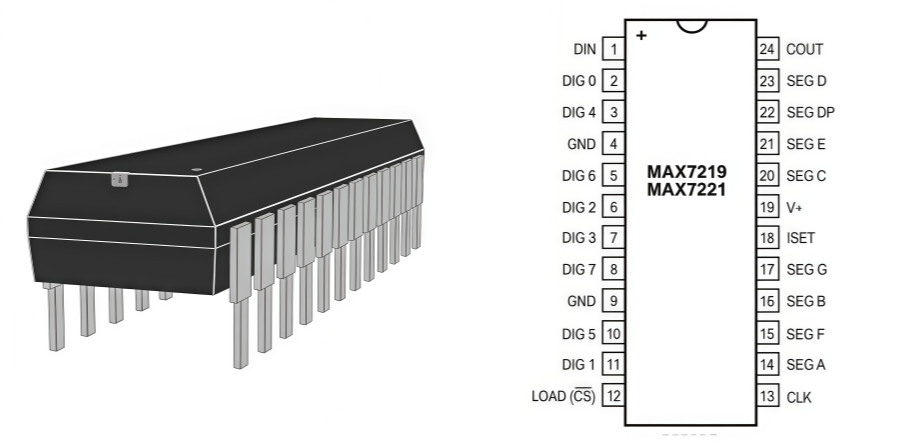
Introduction to MAX7219CNGMAX7219CNG is an integrated serial-input/serial-output LED display driver designed to interface microprocessors with LED display devices. It can drive up to eight digits of common-cathode 7-segment displays, bar-graph displays, or up to 64 individual LEDs, making it suitable for digital displays, counters, measurement equipment, and embedded systems.The MAX7219CNG integrates a BCD code-B decoder, multiplex scan circuitry, segment and digit drivers, and an 8×8 static RAM for storing display data. It uses a simple 4-wire serial interface to communicate with an MCU, while only one external resistor is required to set the segment current for all LEDs. Individual digits can also be addressed and updated without rewriting the entire display, helping simplify the overall display circuit.In terms of functionality, the MAX7219CNG supports both decode and no-decode modes, allowing flexible control of different LED display types. It also provides a selectable scan range from 1 to 8 digits, digital and analog brightness control, a low-power shutdown mode, and an LED test mode. These integrated features reduce MCU I/O requirements and simplify the design of multi-digit LED display systems.(Contact us for a quote) MAX7219CNG SpecificationsThis section lists the key specifications of the MAX7219CNG LED display driver.ParameterValuePart NumberMAX7219CNGManufacturerAnalog Devices / Maxim IntegratedDescriptionIC DRIVER LED DISPLAY 8DGT 24DIPLead Free Status / RoHS StatusLead free / RoHS CompliantMounting TypeThrough HoleConfiguration7 Segment + DPInterface4-Wire SerialCurrent - Supply330mAVoltage - Supply4 V ~ 5.5 VDisplay TypeLEDDigits or Characters8 DigitsPackagingTubeOperating Temperature0°C ~ 70°CSupplier Device Package24-PDIPPackage / Case24-DIP (0.300, 7.62mm)Base Part NumberMAX7219 MAX7219CNG Pinout The MAX7219CNG is housed in a standard 24-pin dual in-line package (PDIP-24), with a clear pin configuration divided into digital control lines, display drive outputs, and power management pins. On the serial communication side, Pin 1 (DIN) receives incoming serial data from the microcontroller, Pin 12 (LOAD/CS) functions as the chip-select/latch input, Pin 13 (CLK) receives the serial clock signal, and Pin 24 (DOUT) outputs serial data for daisy-chaining multiple MAX7219 drivers.On the display driving and power side, DIG 0–DIG 7 (Pins 2, 3, 5, 6, 7, 8, 10, 11) serve as digit-select lines that sink current from common-cathode LED displays or matrix columns. SEG A–SEG G and SEG DP (Pins 14–17, 20–23) act as segment-drive outputs that source current to the LED anodes. Additionally, Pin 19 (V+) and Pins 4 and 9 (GND) provide +5V logic power and ground connections, while Pin 18 (ISET) connects through an external resistor to V+ to set the peak segment current across all LEDs. MAX7219CNG Typical Circuit and Wiring The MAX7219CNG uses a simple serial interface to connect with an MCU and control LED display devices. The basic connection requires DIN, CLK, and LOAD/CS for data communication, along with VCC and GND for power. An external resistor is also used to set the LED segment current. MAX7219 with 7-Segment DisplayFor an 8-digit common-cathode 7-segment display, the MAX7219CNG connects its segment outputs to the display segments and its digit outputs to the individual digit positions. The internal multiplex scanning circuit controls the digits sequentially, allowing the MCU to update the displayed data through the serial interface without directly controlling each LED segment. MAX7219 with LED MatrixThe MAX7219CNG can also drive an 8×8 LED matrix by using its segment and digit outputs to control the LED rows and columns. This configuration allows the MCU to send display data serially while the MAX7219CNG handles scanning and LED driving internally. For the MCU connection, MCU → DIN, MCU → CLK, and MCU → LOAD/CS are used for serial communication, while VCC and GND provide power to the driver and display circuit. MAX7219CNG with ArduinoMAX7219CNG can be easily connected to Arduino through a simple serial interface. The basic connection uses DIN, CLK, and CS/LOAD for data communication, while VCC and GND provide power.l DIN: Arduino sends display data to the MAX7219CNG.l CLK: Provides the serial clock signal.l CS/LOAD: Loads the received data.l VCC/GND: Connect to the appropriate power and ground.MAX7219CNG can drive 8-digit 7-segment displays or 8×8 LED matrices. Multiple MAX7219 devices can also be cascaded to control larger displays while using only a few Arduino I/O pins. Key Features of MAX7219CNGThe features and advantages of MAX7219 are listed below:l 10MHz Serial Interfacel Individual LED Segment Controll Decode/No-Decode Digit Selectionl 150μA Low-Power Shutdown (Data Retained)l Digital and Analog Brightness Controll Display Blanked on Power-Upl Drive Common-Cathode LED Displayl Slew-Rate Limited Segment Drivers for Lower EMIl SPI, QSPI, MICROWIRE Serial Interfacel 24-Pin DIP Packages(Contact us for a quote) Applications of MAX7219CNGMAX7219CNG is widely used in electronic systems that require simple and efficient LED display control. Its integrated scanning and driving functions make it suitable for various numeric, bar-graph, and matrix display applications. 1. Bar-Graph DisplaysMAX7219CNG can drive bar-graph displays to show signal levels, measurement values, or system status in an easy-to-read format. 2. Industrial ControllersIt can be used in industrial controllers to display operating parameters, equipment status, and warning information. 3. Panel MetersMAX7219CNG is suitable for digital panel meters used to display voltage, current, temperature, and other measured values. 4. LED Matrix DisplaysThe device can control up to 64 individual LEDs, making it suitable for 8×8 LED matrix displays, simple characters, symbols, and status indicators. 5. Digital Clocks and CountersMAX7219CNG can drive multi-digit 7-segment displays for digital clocks, timers, counters, and other numeric display devices. 6. Embedded Display SystemsIt can be integrated into MCU-based embedded systems to provide compact numeric or LED status displays while reducing the number of required MCU I/O pins. MAX7219 vs. MAX7221MAX7219 and MAX7221 are both 8-digit LED display drivers with fully compatible pinouts and core functions. The main differences are their communication protocols and EMI performance:l Interface Protocol: MAX7219 uses a proprietary shift-register/latch interface, while MAX7221 is fully compatible with standard SPI/QSPI protocols.l EMI and Slew Rate: MAX7221 uses slew-rate-limited segment drivers to reduce electromagnetic interference (EMI), while MAX7219 has no slew-rate limiting and may produce more noise during high-speed switching.l Selection Guide: MAX7219 is a good choice for general projects, 7-segment displays, LED matrices, and DIY applications. MAX7221 is recommended for EMI-sensitive applications such as medical equipment, industrial instruments, and devices sharing an SPI bus. ANDE Electronics: Your Trusted Partner in Electronic Component SourcingAt ANDE Electronics, we make getting the electronic components you need simple and fast. We work directly with top global manufacturers to provide high-quality components that have passed our strict checks, so you can count on them for your projects.We also focus on quick and consistent delivery to keep your work on schedule and avoid delays. When you need reliable and efficient electronic parts for your projects, ANDE Electronics is a partner you can trust.(Contact us for a quote)
348