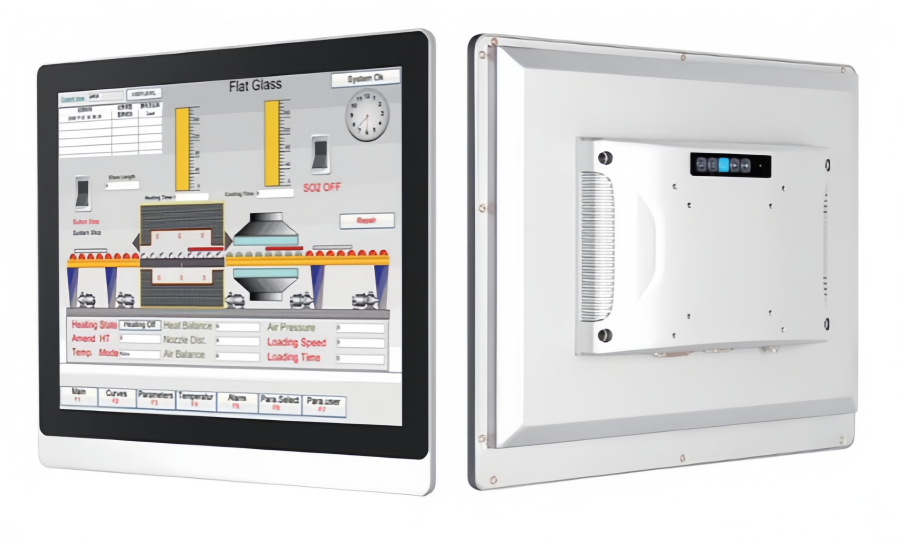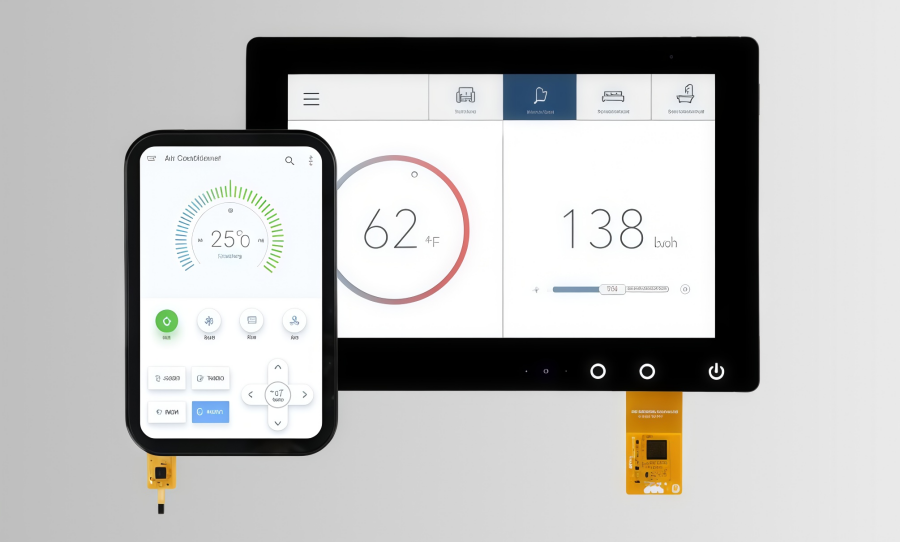
In industrial applications, display modules play a pivotal role as core components for human-machine interaction. Kyocera KCB104VG2BA-A21 is a 10.4-inch diagonal CSTN-LCD display panel widely utilized in various control equipment, instrumentation, and similar devices.
This article analyzes the KCB104VG2BA-A21's characteristics, specifications, operating principles, and typical applications to help engineers better understand its performance advantages and suitable use cases.
KCB104VG2BA-A21 Overview
KCB104VG2BA-A21 is a 10.4'' display panel product introduced by Kyocera Display Corporation. It features an integrated CCFL backlight system and does not include a touch screen.
In terms of environmental adaptability, this model supports an operating temperature range of 0 to 40℃ and a storage temperature range of -20 to 60°C, making it suitable for general industrial environments. Additionally, its typical characteristics include a lifespan of approximately ≥50,000 hours and a matte surface treatment, which helps reduce glare interference and improve visibility.
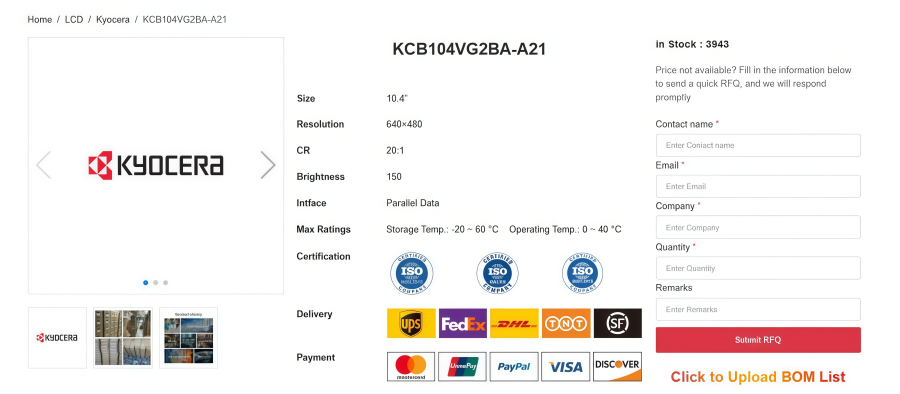
KCB104VG2BA-A21 Technical Specs
In this part, we will explain the key technical specifications of the KCB104VG2BA-A21, providing you with a more intuitive understanding of this model's primary design parameters and performance range.
Parameter | Value |
Brand | Kyocera |
Model | KCB104VG2BA-A21 |
Size | 10.4" |
Composition | LCM |
Resolution | 640(RGB)×480, VGA 76PPI |
Luminance | 150 cd/m² (Typ.) |
Contrast Ratio | 20:1 (Typ.) (TM) |
Viewangle | 45/45/35/20 |
Color Depth | 262K |
Light Source | 2 pcs CCFL , 60K hours , Optional |
Interface Type | Parallel Data (1ch, 8-bit) , Connector 29 pins |
Active Area | 217.2(W)×164.4(H) mm |
Pixel Format | RGB Vertical Stripe |
Frame Rate | 75Hz |
Touchscreen | Without |
Voltage Supply | 5.0V (Typ.) |
Weight | 540g (Typ.) |
Outline Size | 264×183×9 (H×V×D) |
Max Ratings | Operating Temperature: -20 ~ 60 °C ; Storage Temperature:0 ~ 40 °C |
KCB104VG2BA-A21 Module Construction
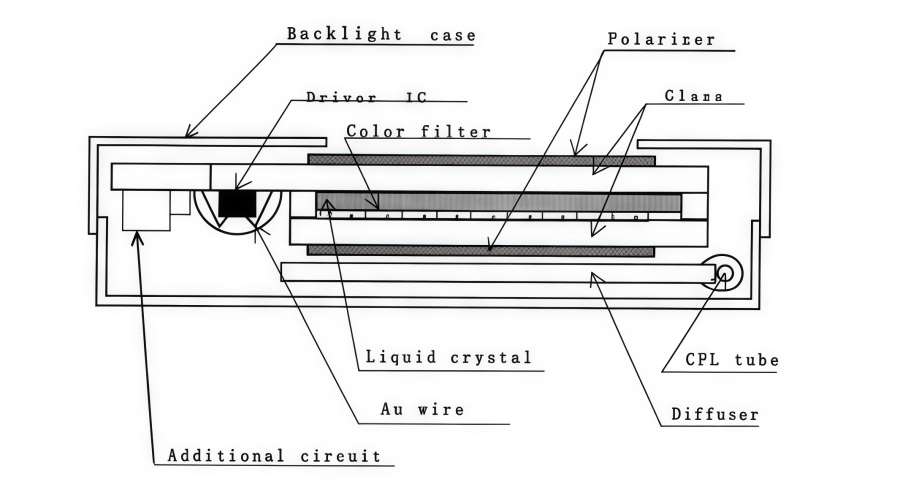
The KCB104VG2BA-A21 LCD panel uses an industrial-grade three-layer sandwich structure for high reliability. Below is its core construction analysis.
Display Core
The center of the module consists of two glass substrates sandwiching liquid crystal molecules. The upper layer integrates a color filter for VGA color output. Polarizers are attached to both inner and outer surfaces to control light transmission and blocking.
Driver & Control
The driver control unit is located on the left side of the module. Driver ICs are bonded to the glass substrate via gold (Au) wires. An additional circuit is mounted outside the module for signal conversion and power management.
Backlight System
It adopts an edge-lit design with a CFL lamp on the right as the light source. A diffuser below ensures uniform light distribution across the display area. The backlight assembly is enclosed in a reinforced backlight case for protection, heat dissipation, and EMI shielding.
KCB104VG2BA-A21 Pin Configuration and Interface
The KCB104VG2BA-A21 adopts a typical industrial TTL (parallel) interface protocol, enabling direct digital communication between the display module and the controller.
1. Interface Type: CMOS / TTL (Parallel)
Unlike LVDS used in modern laptops, this module uses parallel data transmission. It typically supports 6-bit RGB data per color channel, enabling 262,144 colors. The driving logic is relatively simple, requiring no complex SerDes circuitry, and can be directly connected to industrial LCD controllers.
2. Key Pin Definition
The module interface is usually a 31-pin or 33-pin connector, consisting of three main groups:
1) Power Supply Pins:
l VCC provides the logic supply voltage (typically +3.3V or +5.0V) for internal circuitry and driver ICs.
l GND is the system ground and must be shared with the main board to avoid signal interference.
2) Signal & Control Pins:
l R0–R5, G0–G5, B0–B5 are RGB data lines.
l CLK is the pixel clock for data synchronization.
l HSYNC / VSYNC define horizontal and vertical synchronization.
l ENAB (Data Enable) indicates valid pixel data on the bus.
3) Backlight Interface:
This is separate from the logic interface and typically includes V-LED/V-CFL and PWM dimming pins for brightness control.
3. Connection with MCU / FPGA
As a parallel interface, integration is typically implemented as follows:
l MCU/MPU connection: Used with processors that include an integrated LCD controller (e.g., NXP i.MX or STM32F4/F7 series), mapping RGB interface signals directly via FPC or adapter board.
l FPGA driving: FPGA generates required timing signals (clock, sync, and data) using HDL such as Verilog or VHDL.
l Signal considerations: Due to the short-range and low noise immunity of TTL signals, cable length is recommended to be within 20 cm, with proper EMI shielding for reliable operation.
KCB104VG2BA-A21 Advantages and Benefits
Next, we will summarize the main advantages and highlights of the KCB104VG2BA-A21 LCD, analyzing it from multiple aspects including stability, service life, interface compatibility, and environmental adaptability.
l Industrial-grade stability: Adopts mature CSTN-LCD technology, suitable for long-term stable operation in industrial environments.
l Long service life: Typical lifespan reaches ≥50,000 hours, reducing maintenance and replacement costs.
l Easy interface integration: Uses a TTL parallel interface, compatible with various MCU/FPGA systems with LCD controllers.
l Stable and reliable display performance: CCFL backlight design provides uniform brightness output and ensures basic display quality.
l Good environmental adaptability: Supports an operating temperature range of 0–40°C, suitable for most industrial applications.
l Matte surface for reduced glare: Matte treatment improves visibility, making it suitable for strong or complex lighting conditions.
Industrial Applications of KCB104VG2BA-A21
Featuring an industrial-grade construction, the KCB104VG2BA-A21 LCD panel delivers stable display performance and a robust structure. It is widely compatible with various industrial scenarios, making it an ideal display solution for industrial control and automation equipment.
1. Industrial Control and Human-Machine Interface (HMI) Devices
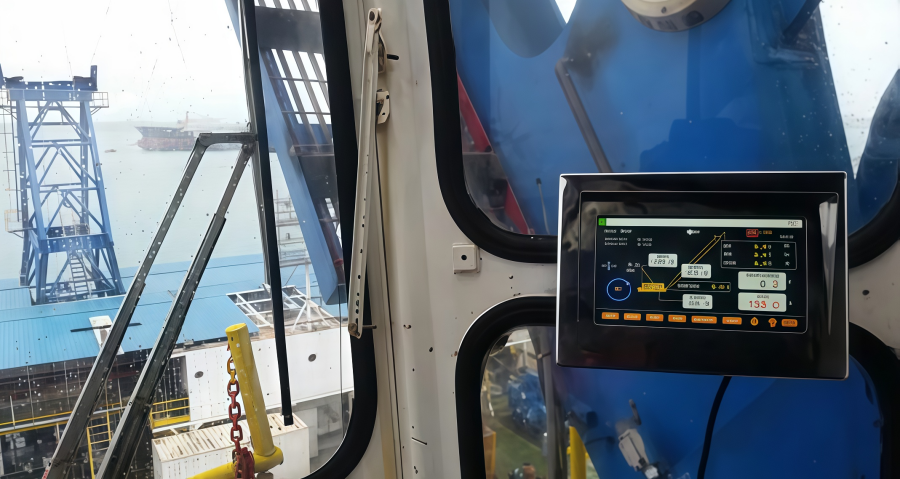
The KCB104VG2BA-A21 is widely used in human-machine interfaces for various industrial control terminals. With stable display performance and a mature TTL interface, it enables a reliable connection to host control systems.
l PLC control panels
l Industrial touch operation terminals
l Equipment status displays
2. Automated Production Equipment
In automated production lines, this display module shows operating status and parameter settings. It helps operators monitor processes in real time, improving efficiency and equipment controllability.
l SMT mounter control panels
l Packaging machinery displays
l Assembly line monitoring terminals
3. Test and Measurement Instruments
This model is suitable for various testing devices to show measured data, waveforms, or system parameters. Its stability and long service life meet long-term laboratory requirements.
l Oscilloscope auxiliary display modules
l Power supply testers
4. Medical and Analytical Equipment
It is used in basic medical and diagnostic devices to show interfaces and test results.Stable output and long lifetime satisfy basic reliability requirements for medical equipment.
l Portable detectors
l Basic monitoring devices
5. Embedded Systems and Custom Terminals
The KCB104VG2BA-A21 is widely applied in embedded control systems as a basic display unit.It works with MCUs or FPGAs to implement customized human-machine interfaces.
l Embedded Linux terminals
l Industrial all-in-one PCs
l Custom control box display solutions
ANDE Electronics: Reliable LCD Display Solutions
As a professional display supplier, Ande Electronics is committed to providing LCD modules that meet modern application needs.
We offer not only high-quality display products but also reliable technical support and flexible purchasing options. Our experienced engineering team works closely with customers to provide guidance on module selection, integration, and optimization.
Choosing Ande Electronics, then engineers and manufacturers will gain a partner focused on quality, innovation, and efficiency.