Introduction and Overview of STM32F767IIT6
The STM32F767IIT6 is a microcontroller based on the Arm Cortex-M7 32-bit RISC core, operating at frequencies of up to 216 MHz. Its core integrates a floating-point unit (FPU) that supports both single-precision and double-precision operations, a digital signal processing (DSP) instruction set, and a memory protection unit (MPU). These features make it suitable for complex computations, real-time control, and embedded system development.
In terms of memory and peripherals, the STM32F767IIT6 provides up to 2 MB of Flash memory and 512 KB of SRAM. It also features ADCs, DACs, timers, a random number generator, and a wide range of communication interfaces, including I²C, SPI, UART/USART, USB, CAN, and Ethernet. In addition, the device supports an LCD-TFT display controller, a Chrom-ART graphics accelerator, and flexible external memory interfaces.
The STM32F767IIT6 supports a supply voltage range of 1.7–3.6 V. Devices in the associated series operate across a temperature range of -40°C to +105°C and offer multiple low-power modes.
STM32F767IIT6 Specifications
This section lists the key specifications of the STM32F767IIT6 microcontroller.
Parameter | Value |
Part Number | STM32F767IIT6 |
Manufacturer | STMicroelectronics |
Description | IC MCU 32BIT 2MB FLASH 176LQFP |
Lead Free Status / RoHS Status | Lead free / RoHS Compliant |
Program Memory Type | FLASH |
Program Memory Size | 2MB (2M x 8) |
RAM Size | 512K x 8 |
Oscillator Type | Internal |
Data Converters | A/D 24x12b, A/D 2x12b |
Core Processor | ARM® Cortex®-M7 |
Number of I/O | 140 |
Speed | 216MHz |
Core Size | 32-Bit |
Voltage - Supply (Vcc/Vdd) | 1.7 V ~ 3.6 V |
Packaging | Tray |
Operating Temperature | -40°C ~ 85°C (TA) |
Supplier Device Package | 176-LQFP (24x24) |
Package / Case | 176-LQFP |
Base Part Number | STM32F7 |
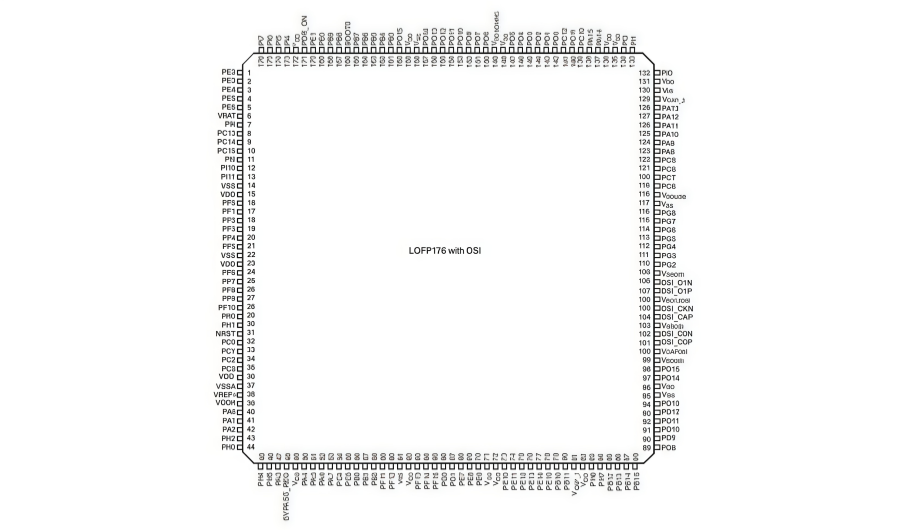
Pinout and Interface Configuration
The STM32F767IIT6 comes in an LQFP176 package, providing extensive multiplexed I/O resources and strong peripheral expansion capabilities. Its pin layout distributes power pins (VDD, VSS, VDDA, etc.), analog reference inputs, and various high-speed communication interfaces around the package to help manage high-frequency switching noise and maintain signal integrity.
Key Features of STM32F767IIT6
l Includes ST state-of-the-art patented technology
l Core: Arm® 32-bit Cortex®-M7 CPU with DPFPU, ART Accelerator and L1-cache: 16 Kbytes I/D cache, allowing 0-wait state execution from embedded flash memory and external memories, up to 216 MHz, MPU, 462 DMIPS/2.14 DMIPS/MHz (Dhrystone 2.1), and DSP instructions.
l Memories
– Up to 2 Mbytes of flash memory, organized into two banks allowing read-while-write
– SRAM: 512 Kbytes (including 128 Kbytes of data TCM RAM for critical real-time data)
+ 16 Kbytes of instruction TCM RAM (for critical real-time routines) + 4 Kbytes of backup
– Flexible external memory controller with up to 32-bit data bus: SRAM, PSRAM, SDRAM/LPSDR SDRAM, NOR/NAND memories
l Dual mode Quad-SPI
l Graphics
– Chrom-ART Accelerator (DMA2D), graphical hardware accelerator enabling enhanced graphical user interface
– Hardware JPEG codec
– LCD-TFT controller supporting up to XGA resolution
– MIPI® DSI host controller supporting up to 720p 30 Hz resolution
l Clock, reset and supply management
– 1.7 to 3.6 V application supply and I/Os
– POR, PDR, PVD and BOR
– Dedicated USB power
– 4-to-26 MHz crystal oscillator
– Internal 16 MHz factory-trimmed RC (1% accuracy)
– 32 kHz oscillator for RTC with calibration
– Internal 32 kHz RC with calibration
l Low-power
– Sleep, Stop and Standby modes
–VBAT supply for RTC, 32×32 bit backup registers + 4 Kbytes backup SRAM
3×12-bit, 2.4 MSPS ADC: up to 24 channels
l Digital filters for sigma delta modulator (DFSDM), 8 channels / 4 filters
l 2×12-bit D/A converters
l General-purpose DMA: 16-stream DMA controller with FIFOs and burst support
l Up to 18 timers: up to thirteen 16-bit (1x lowpower 16-bit timer available in Stop mode) and two 32-bit timers, each with up to four IC/OC/PWM or pulse counter and quadrature (incremental) encoder input. All 15 timers running up to 216 MHz. 2x watchdogs, SysTick timer
l Debug mode
– SWD and JTAG interfaces
– Cortex®-M7 Trace Macrocell™
l Up to 168 I/O ports with interrupt capability
– Up to 164 fast I/Os up to 108 MHz
– Up to 166 5 V-tolerant I/Os
ARM Cortex-M7 Core Architecture and Performance
The STM32F767IIT6 features STMicroelectronics’ high-performance ARM Cortex-M7 32-bit RISC core, based on the ARMv7-M architecture, with a maximum clock speed of 216 MHz. Its key architectural advantages include:
1. L1 Cache
The Cortex-M7 integrates L1 instruction cache (I-Cache) and data cache (D-Cache). These caches reduce CPU stalls caused by Flash access, improving code execution and data processing efficiency.
2. Hardware FPU
The chip includes a high-performance hardware floating-point unit (FPU) compliant with IEEE 754. It supports single-precision operations and accelerates mathematical computations such as PID control, digital filtering, and Fast Fourier Transform (FFT), reducing execution time compared with software-based calculations.
3. Double-Precision Computing
In addition to single-precision operations, the Cortex-M7 supports hardware-accelerated double-precision (64-bit) floating-point calculations. This benefits applications requiring high-precision scientific computing, precision measurements, and complex matrix operations.
4. Support for Complex Algorithms
With a clock speed of up to 216 MHz, the Cortex-M7 handles real-time control tasks and runs embedded operating systems such as FreeRTOS and ThreadX, as well as computationally intensive algorithms.
Memory Organization: Flash and SRAM Capacity
The STM32F767IIT6 features up to 2 MB of Flash and 512 KB of SRAM, with a multi-level memory architecture designed for high-speed, real-time data processing.
l 2 MB Dual-Bank Flash: Provides ample space for embedded operating systems such as FreeRTOS, protocol stacks, and GUI assets. The dual-bank architecture supports read-while-write operations, enabling firmware updates while the application continues running, subject to implementation requirements.
l 512 KB SRAM and TCM: The device provides 512 KB of SRAM for data buffers and network packets. Its Instruction Tightly Coupled Memory (ITCM) and Data Tightly Coupled Memory (DTCM) connect directly to the Cortex-M7 core, enabling low-latency access.
l Optimized Real-Time Processing: Developers can place time-critical algorithms, digital filters, and interrupt routines in ITCM, while storing frequently accessed real-time variables in DTCM to improve execution efficiency.
Typical Applications of STM32F767IIT6 MCU
The microcontroller is suitable for a wide range of applications thanks to its high processing performance, rich peripheral interfaces, and real-time control capabilities. Typical applications include:
1. Motor Drives and Application Control
The STM32F767IIT6 is suitable for controlling BLDC motors, servo motors, and other motor-driven systems that require fast response and accurate speed regulation.
2. Medical Equipment
It can be used in medical equipment such as patient monitoring systems, diagnostic instruments, and portable medical devices.
3. Industrial Applications
The STM32F767IIT6 is good for industrial control systems, including programmable logic controllers (PLCs), inverters, and circuit breakers.
4. Printers and Scanners
The MCU can manage data processing, motor control, and communication in printers and scanners.
5. Alarm Systems, Video Intercoms, and HVAC
The STM32F767IIT6 can serve as a control unit in security and building automation systems. It supports sensor data acquisition, alarm processing, communication, user interface control, and more.
6. Home Audio Appliances
The STM32F767IIT6 can handle audio signal processing and system control in home audio equipment. Typical applications include audio processors, digital amplifiers, and smart speakers.
7. Mobile Applications and Internet of Things (IoT)
The STM32F767IIT6 provides the processing power and connectivity interfaces needed for IoT devices and portable electronic systems.
8. Wearable Devices
The microcontroller can support wearable devices such as smartwatches that require sensor data processing, display control, and wireless communication through external modules.
ANDE Electronics: Your Trusted Partner in Electronic Component Sourcing
At ANDE Electronics, we make getting the electronic components you need simple and fast. We work directly with top global manufacturers to provide high-quality components that have passed our strict checks, so you can count on them for your projects.
We also focus on quick and consistent delivery to keep your work on schedule and avoid delays. When you need reliable and efficient electronic parts for your projects, ANDE Electronics is a partner you can trust.